The Dark Mirror of Identity
An introduction to identity as the last bastion of freedom in an age of great-power rivalry.

On the night of March 27, 1943, a group of Dutch resistance fighters carried out one of the boldest acts of defiance in occupied Amsterdam. They broke into the Bevolkingsregister — the city’s civil registry — and set fire to the records inside, destroying hundreds of identity cards. This was not a reckless outburst, but a deliberate attempt to dismantle a system that had turned bureaucracy into a weapon: a mechanism enabling the Nazi regime to track, arrest, and deport thousands of civilians. To understand the moral and historical weight of this action, we must first examine the machinery it sought to disrupt. What follows is not only an account of facts, but also a reflection on the human urgency that drove such resistance.
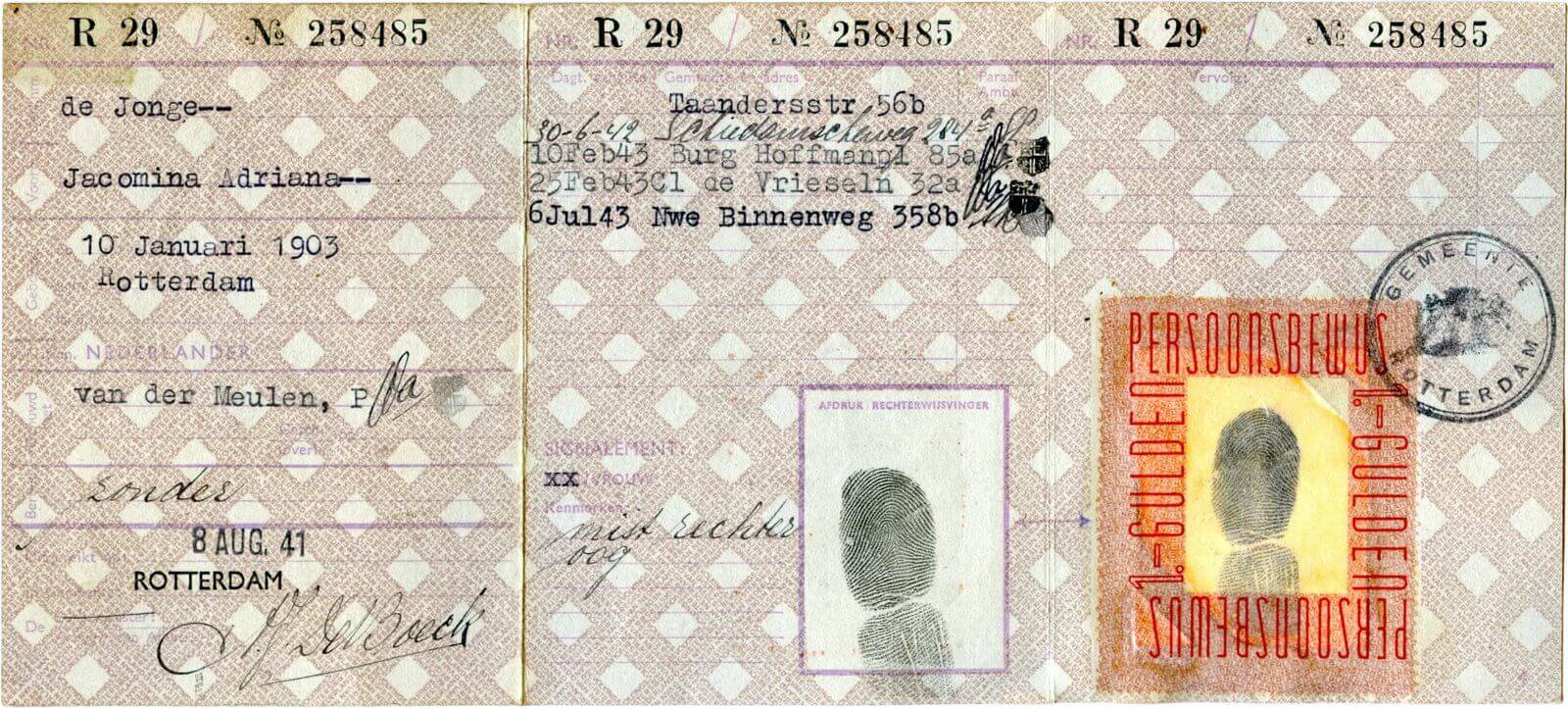
A Proof of Identity from 1941.
The story begins in the 1930s, when the Great Depression swept through Europe, deepening the social and economic inequalities that had emerged after the First World War. In response, governments experimented with new tools to manage welfare and improve public services.
The Netherlands quickly stood out as a pioneer. Its efficient civil service provided citizens with birth certificates and identification documents, which guaranteed access to healthcare, housing, and other essential services. By the mid-1930s, the Dutch model was considered among the most advanced in Europe: a sign of modern governance, technological progress, and social justice.
In 1936, the government expanded this initiative by introducing mandatory identity cards for all residents. Each card contained biometric information (photographs and fingerprints), with one copy given to the citizen and another stored in a central archive. At the time, this system embodied reliability, order, and the promise of social welfare.
The German occupation of the 1940s turned this promise into peril. What had been created for welfare and administration was swiftly repurposed for surveillance and control. Identity cards became tools for tracking ethnic minorities, especially Jews. They revealed addresses, family members, and even the number of children in each household. Forgery attempts by the resistance proved almost futile: at any moment, an officer could demand a card, verify it against municipal records, and expose a forgery. Archives became instruments of repression, making resistance efforts both dangerous and fragile.
Faced with this harsh reality, members of the resistance resolved to eradicate the evil at its root. On the night of March 27, 1943, a coordinated group of thirty individuals launched an attack on the Bevolkingsregister in Amsterdam, aiming to destroy the identity records stored within. Although the resistance managed to inflict significant damage, only around 15% of the records were permanently lost. As a result, the action—while symbolically powerful—had limited practical impact on the Nazis' ability to identify and deport civilians. It illustrates how identification documents, once co-opted by authoritarian regimes, can be transformed from tools of protection into instruments of oppression, ultimately endangering the very people they were intended to serve.
A comparison with other countries, such as France, reveals a potentially different outcome. The Vichy government, which initially collaborated with the Nazis, later sought to limit the mass deportation of civilians and, by 1943, began to withdraw its support. Without this cooperation, the Nazis were largely left to operate on their own and faced significant obstacles due to the absence of a centralized administrative archive. The lack of reliable records severely hindered their ability to track and identify minority populations. Quite simply, they did not have the data. The absence of a central registry—and of detailed personal records—rendered the Nazi apparatus less effective and ultimately mitigated its impact on the civilian population.
As a result, approximately 23% of Jewish residents in France were deported—far fewer than the estimated 75% in the Netherlands. This tragic contrast highlights the deadly consequences of poor identity system design when exploited by authoritarian regimes.
“When authority became a threat, our government institutions failed as guardians of law and security.”
— Mark Rutte
This admission underlines a crucial lesson: trust in institutions must always be paired with strong safeguards. Even systems designed to protect can become tools of harm, because we cannot foresee the future. An identity card can shield or endanger—and history shows how quickly it can betray those it was meant to protect. This is not just history; it is also a warning.
Today, identity is managed through centralized digital services. These systems may function well now, but their potential for failure or abuse is undeniable. What kind of resistance is possible if such systems turn oppressive? What alternatives can be built? The stakes are higher than ever, and it is urgent to rethink identity systems in terms of autonomy, transparency, and individual control.
Behind this vision is a growing movement of technologists, thinkers, and philanthropists united by a common goal: ensuring that history’s darkest lessons are not repeated. In this light, two key questions arise:
How can we rethink identity around fundamental human rights?
How can we ensure that well-intentioned actors can safeguard our identity tomorrow?
These questions highlight some of today’s most pressing threats. It is not enough to recognize risks; we must also ask who holds the power to define and shape identity. Individuals, institutions, and communities of good will must be empowered to resist harmful uses, guided by ethics, transparency, and respect for rights.
Supporting these actors is vital to preventing identity systems from being co-opted for authoritarian, discriminatory, or surveillance purposes. The challenge is twofold: identifying trustworthy actors capable of shaping a pluralistic, rights-respecting technological future, and building safeguards—legal, institutional, and technical—that preserve identity sovereignty, protecting freedom, dignity, and social inclusion. The memory of those who risked everything reminds us: freedom requires not only design, but courage.
This story is not just a historical episode. It reflects dynamics of power, the fragility of identity systems, and the tension between control and freedom. It is precisely this tension that frames the theoretical and methodological reflections that follow, providing the background for analyzing contemporary challenges in digital identity.
Aims and Scope
This reading explored the evolving discourse on the identity landscape, questioning whether today’s systems truly reflect principles of user empowerment and rights protection—or merely reproduce the same vulnerabilities under a more modern, technological guise.
We explored the enduring tension between identity as an instrument of control and as a space for autonomy. It seeks to imagine a foundation for future systems that protect human dignity and remain open to being judged—or reclaimed—in the name of freedom and democratic values.
Written by
Cristian Lepore